Choosing the manufacturing process for a new part sets its cost, lead time and quality for the life of the program. For small-to-midsize metal parts needed in large, steady quantities, progressive die stamping is usually the first process to evaluate. One coil of metal, one die and one press produce a finished part on nearly every stroke. This guide explains how the progressive die stamping process works station by station, where it beats transfer die and single-hit stamping, and which factors actually drive tooling and per-part cost. It comes from inside a stamping operation: Prestige Stamping is an IATF 16949-certified manufacturer in Warren, Michigan, with 22 high-speed presses and its own tool design and build department.
What Is Progressive Die Stamping?
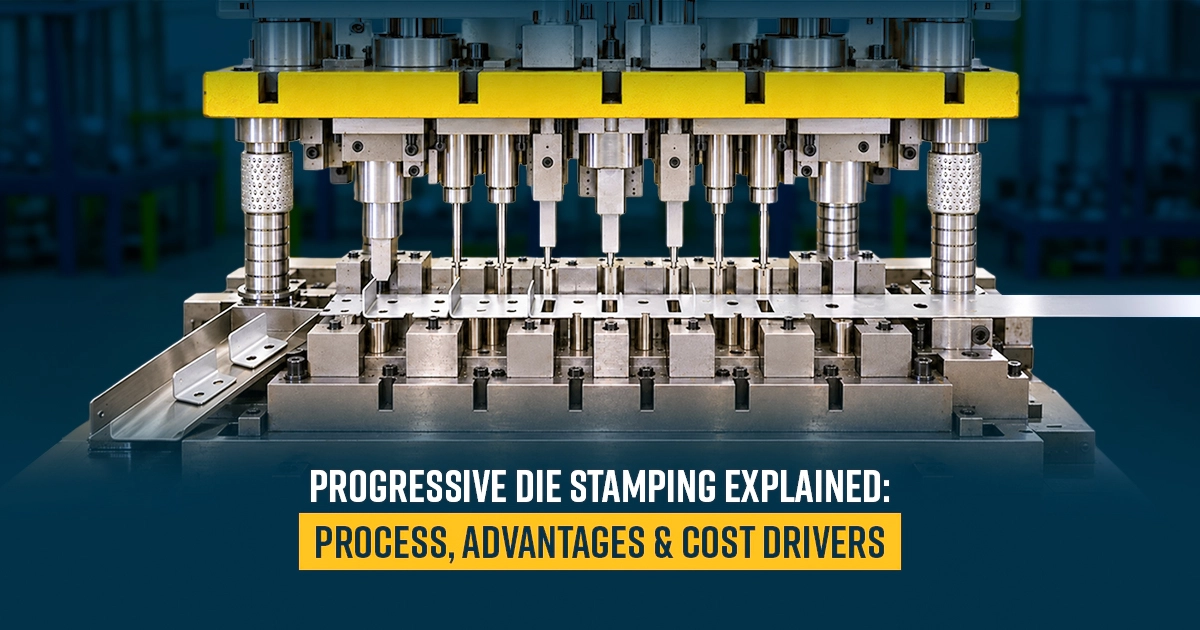
Progressive die stamping is a cold-forming process that turns a continuous strip of coil stock into finished parts using a single die with multiple stations. Each station performs one operation, such as piercing, blanking, bending or forming. With every press stroke, the strip advances one fixed step, called the pitch, and every partially formed part moves to the next station.
The part stays attached to the strip by a carrier web until the final station, where a cut-off operation separates it from the scrap skeleton. Because the strip itself carries the part from station to station, no operator or robot has to move it between operations.
That is why the process exists: it completes a multi-feature part without separate machine setups, manual handling or a separate operator for each operation. Single-hit dies, including compound dies, do their cutting at one station in one stroke, usually on individual blanks. A compound die can blank and pierce at the same time, but it cannot build up a part through several forming steps the way a progressive die does. Transfer die stamping cuts each blank free and moves it mechanically between separate stations. Which of the three fits depends on part size, geometry and volume, and the comparison later in this guide shows where each one wins.
If you want the wider context first, our overview of how metal stamping works covers the main stamping techniques side by side.
How the Progressive Die Stamping Process Works
The process starts before the metal reaches the die. A coil is loaded onto an uncoiler, passed through a straightener that removes the curvature the metal picked up on the coil, and fed into the press by an automatic feeder. From there, the strip moves through the die in these stages.
Station-by-Station Breakdown
- Piercing and piloting. The first stations pierce pilot holes in the carrier web. On every later stroke, pilot pins enter those holes just before the die closes and register the strip, correcting small feed errors so every feature lands where it should.
- Blanking and notching. Early stations remove the material that defines the part’s outline, leaving the part attached to the carrier.
- Forming and bending. As the strip advances, forming stations bend flanges, raise ribs and make shallow draws. Deeper draws usually move to a transfer die, because a deep draw can pull the strip out of position or tear the carrier.
- Coining and finishing operations. High-pressure stations set precise dimensions, add edge chamfers or reduce thickness in specific areas.
- Cut-off. The last station shears the finished part from the carrier. The part drops into a chute and the scrap web leaves the die for recycling.
Because every station works at the same time, a ten-station die has ten parts in process on each stroke. Once the strip is full, one finished part leaves the die per stroke, or more if the die is built to make several parts at once.
Die and Press Components
A progressive stamping die is a precision assembly of tool steel. The upper half mounts to the press ram and the lower half to the bolster. Guide pins and bushings keep the halves aligned through millions of cycles, strippers pull the strip off the punches, and sensors can stop the press if the strip misfeeds. Depending on the part, a die can have anywhere from about four stations to twenty or more.
Stamping press tonnage has to cover the cutting force plus the forming loads at every station. Cutting force rises in proportion to the length of the cut edge, the thickness of the material and its shear strength, so thicker, stronger material and longer cut perimeters call for larger presses. Prestige’s press room runs 22 high-speed presses from 35 to 250 tons and stamps coil from .020 to .375 inch thick.
Strip layout is how the part is nested and oriented on the coil. It sets the pitch, the strip width and how much scrap web the die produces, which makes it a direct material cost lever. The cost section below shows how much.
Progressive Die vs. Transfer Die Stamping
Both are automated, high-speed processes, but they move the work differently, and that decides where each one fits.
| Factor | Progressive die | Transfer die |
|---|---|---|
| How parts move | Part stays on the carrier strip through every station | Each blank is cut free, then moved between stations by fingers or rails |
| Typical part size | Small to midsize | Midsize to large |
| Forming depth | Shallow to moderate | Deep draws and complex three-dimensional forms |
| Best fit | Very high, steady volume | High to medium volume, larger or deeper parts |
| Scrap | The carrier web adds scrap | Blanks can often be nested more tightly |
The rule of thumb: if the part is small and stable enough to stay on a carrier strip and the annual volume is high, a progressive die usually wins on both per-part cost and speed. If the part is large, deeply formed, or needs to be handled from several directions, transfer tooling is usually the better answer.
Advantages of Progressive Die Stamping
Speed and High-Volume Output
Every station works on a different part during each stroke, so output is set mainly by press speed rather than by the number of operations. Very complex dies often run slower than simple ones, but the principle holds. At 200 strokes per minute, one part per stroke is 12,000 parts per hour, and presses built for high-speed progressive stamping of small parts can run several times faster. Prestige’s own history shows what high-speed pressing makes possible: a new 90-ton high-speed press let the company take on two automotive programs running 376 million and 170 million pieces a year.
Precision and Repeatability
In a progressive die, the relationships between holes, bends and forms are built into one rigid piece of tooling, and pilot pins re-register the strip on every stroke. That keeps part-to-part consistency tight across long runs. It does not make the millionth part identical to the first on its own: dies wear, so repeatability depends on scheduled die maintenance, in-process checks and a controlled process. That is what an IATF 16949 quality system is built to enforce. Automated stamping reduces scrap and improves tolerance consistency, and Prestige runs eight automated and digital sorting machines behind its presses.
Lower Per-Part Cost at High Volume
Multiple operations happen in one pass, watched by one operator, so labor and handling cost per part fall as volume rises. Once the die is paid for, the cost of an extra part is mostly material and press time. At high volume that is far below the per-part cost of machining or manual fabrication.
Less Secondary Handling
Parts come off the press finished or close to it. That cuts work-in-process inventory, shop-floor space and the risk of parts being dropped, scratched or lost moving between workstations.
Cost Drivers in Progressive Die Stamping
A low per-part price is the result of a large up-front investment, so it helps to understand what drives it. The quoted price is only part of the picture, as our guide to what matters more than the quoted price explains. Five factors do most of the work.
Tooling and Die Design Cost
The die is the largest up-front cost. It covers design, machining, wire EDM, heat treatment, grinding and tryout, and it rises with the number of stations and the difficulty of each one. Published industry ranges vary widely: small, simple progressive dies are commonly quoted from roughly $10,000 to $35,000, while complex multi-station dies can run from $75,000 to well over $100,000. Your part’s real number comes from a quote based on your drawing. An early design review, like the one described in our custom stamping process, is the cheapest way to take cost out of the die.
Tooling cost is spread across every part you buy. Using a $40,000 die as an example:
| Total parts over the program | Tooling cost per part |
|---|---|
| 5,000 | $8.00 |
| 50,000 | $0.80 |
| 500,000 | $0.08 |
| 5,000,000 | $0.008 |
Prestige designs and builds tooling in house, and for washer-style parts it runs master dies and thousands of standard tool combinations, which in many cases lowers or avoids new tooling cost.
Part Complexity and Station Count
Every extra feature, such as a tapped hole, a tight bend, a deep draw or a coined detail, can add a station. More stations mean a longer, heavier and more expensive die, a larger press bed and a longer design and build time. A design change after the die is largely built can be costly because hardened tool steel has to be reworked. Simplifying the part before tooling is released is the most effective way to cut die cost.
Material and Strip Layout Efficiency
How well the part nests on the coil determines how much metal ends up as scrap. Here is an illustration with assumed numbers: if a part contains $0.10 of metal and the strip layout uses 60 percent of the coil, the material cost per good part is about $0.167. Improve the layout to 75 percent and it drops to about $0.133, a saving of roughly $0.033 per part, or about $167,000 over a 5 million piece program, with no change to the tooling price. Material grade and thickness matter too. Prestige stamps SAE 1008 to 1075 steels, stainless and pre-tempered steels, aluminum, brass and copper, and most high-strength materials.
Tolerances, Heat Treating and Finishing
Tighter tolerances add die build and tryout time, and some features may need a secondary operation. Heat treating and plating add cost and lead time, and every handoff to an outside vendor adds more. Prestige offers case hardening, carbonitriding, through hardening, surface hardening and bright annealing (austempering is handled externally), along with zinc, nickel, anodizing, phosphate, Dacromet and galvanizing among its plated finishes.
Production Volume and Break-Even
Progressive tooling only pays for itself at volume. The break-even quantity is the tooling cost divided by the per-part saving over the alternative. As an illustration, suppose a $40,000 die produces a part for $0.12, while the alternative (laser cutting and bending, for example) costs $0.60 per part. The saving is $0.48 per part, so the die pays for itself after about 83,000 parts. If the program will never reach that quantity, a simpler tool or a different process costs less overall. Your alternative’s real cost sets the real break-even, which is why volume is the most important number to settle early.
When Progressive Die Stamping Makes Sense
Best fit. Small-to-midsize parts needed at consistently high volumes, with a mature design that is fully validated and not expected to change mid-run. Automotive programs are a natural match, and why automotive manufacturers choose custom metal stamping covers that side in detail. You can see the kinds of parts Prestige stamps on its custom and specialty stampings page.
Reconsider if:
- Volume is low enough that you will never repay the die.
- The part is large, or deep enough that a transfer die is needed.
- The design is still changing. Modifying hardened tooling after it is built is expensive and slow, so prototype first and tool once the design is frozen.
Conclusion
Progressive die stamping gives the lowest per-part cost and the fastest output for the right part, but only when volume is high enough to repay the die. The practical test is simple: estimate annual volume, get a tooling quote and compare the break-even quantity against your alternative. If you already have a drawing and a volume estimate, talk to our stamping engineers about whether a progressive die fits your part and what it would involve.
Frequently Asked Questions
What is a progressive die?
A progressive die is a multi-station tool used in a stamping press. A continuous strip of metal moves through it one step per stroke, and each station performs a different cutting or forming operation until the finished part is cut from the strip.
What’s the difference between progressive die and transfer die stamping?
In progressive stamping, the part stays attached to the carrier strip as it moves through the stations. In transfer die stamping, the part is cut free from the strip early and moved between separate stations by fingers or rails, which suits larger and more deeply formed parts.
How much does progressive die tooling typically cost?
It depends on part size, station count, material and tolerances. Published industry ranges run from roughly $10,000 for a small, simple die to well over $100,000 for a complex multi-station die. A quote based on your drawing gives the real figure, and the right way to judge it is tooling plus per-part price over the life of the program, not tooling alone.
What volume justifies progressive die tooling versus a simpler stamping method?
There is no single threshold. Divide the tooling cost by the per-part saving over your alternative to find the break-even quantity, as in the example above. Many programs justify progressive tooling at tens of thousands of parts a year or more, but a cheaper alternative pushes that number up and a very low per-part cost pulls it down.
How long does it take to design and build a progressive die?
Commonly 8 to 18 weeks from approved design to a die that runs good parts, including machining, heat treatment, grinding and tryout. Simple tools are faster and complex multi-station dies sit at the long end. Prestige builds its own tooling, and working with a domestic supplier shortens the loop for adjustments, as covered in how domestic manufacturing strengthens your supply chain.
What materials work best in progressive die stamping?
Progressive stamping handles a wide range of coil material, provided the thickness and temper suit the forming operations. Prestige stamps coil from .020 to .375 inch thick in SAE 1008 to 1075 steels, pre-tempered and stainless steels, aluminum, brass and copper, plus most high-strength materials.