Industries worldwide, including OEMs, rely on high-quality metal parts such as washers, shims, brackets, and terminals. Sectors like automotive, industrial machinery, aerospace, and construction frequently require large volumes of these precision components.
The global stamping components market is projected to reach USD 257.26 billion in 2025 and is expected to grow to approximately USD 373.85 billion by 2033, at a CAGR of 5.0%. This stat reflects the increasing demand for high-quality metal stamping components across industries.
In this blog, we will explore the metal stamping process, the different types of stamping, and why stamping components are essential in manufacturing.
What Is Metal Stamping?
Metal stamping is a manufacturing process that converts flat sheet metal into specific shapes using dies and high-speed presses. It enables the production of large volumes of parts with specific dimensions and consistent quality.
Common materials used in metal stamping include steel, stainless steel, aluminum, and copper alloys. These materials are selected based on strength requirements, corrosion resistance, and application needs.
Metal-stamped parts, such as washers, brackets, and shims, are used in a wide range of applications, including mechanical assemblies that require high-strength and precision.
How Metal Stamping Works
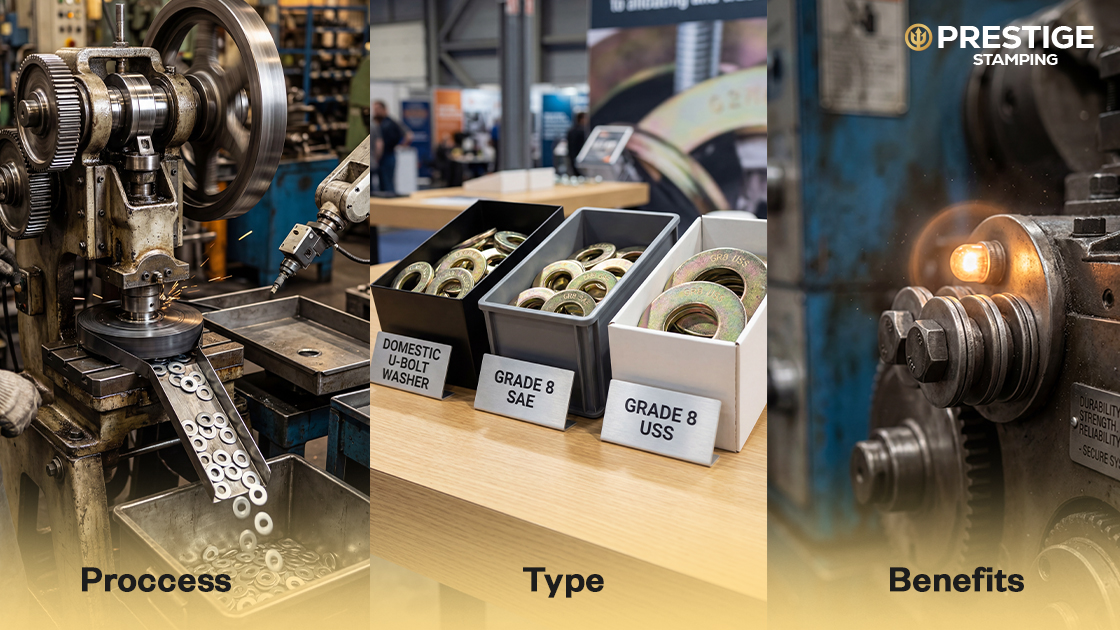
Metal stamping transforms flat sheet metal into small parts by combining advanced presses, skilled engineers, and modern digital tools. The steps to manufacturing stamping components include:
1. Die Design and Tooling
The process begins with designing the component and its custom die using CAD (Computer-Aided Design) software. Engineers create detailed 2D and 3D models that specify dimensions, tolerances, and functional features. These digital designs are then optimized using CAM (Computer-Aided Manufacturing) software to guide the die-making process.
This ensures accurate tooling, reduces material waste, and predicts how the sheet metal will behave during forming. This step also defines the part’s final shape, surface quality, and the tolerances necessary for consistent, high-volume production.
2. Material Feeding
In this step, prepared sheet metal is fed into the press manually or via automated systems, such as coil feeders or robotic handling equipment. The choice of feeding method depends on part complexity, production volume, and automation level. Accurate feeding ensures proper alignment with the die, minimizes scrap, and maintains consistent results.
3. Forming and Cutting
Once the material is fed into the press, controlled force is applied through the die to shape the metal through operations such as blanking, piercing, bending, forming, and coining. Each press stroke produces a precise, repeatable component. Modern presses can operate at high speed with programmable motion control to maintain tight tolerances, even in complex geometries. The combination of die design and forming operations ensures that every part meets the required specifications for size, shape, and functionality.
4. Secondary Operations
After stamping, additional processes may be performed to meet design and functional requirements. These include deburring to remove sharp edges, tapping or threading for fastener holes, and welding or assembly operations for multi-part components. Secondary operations enhance the usability and quality of the finished parts.
5. Finishing and Inspection
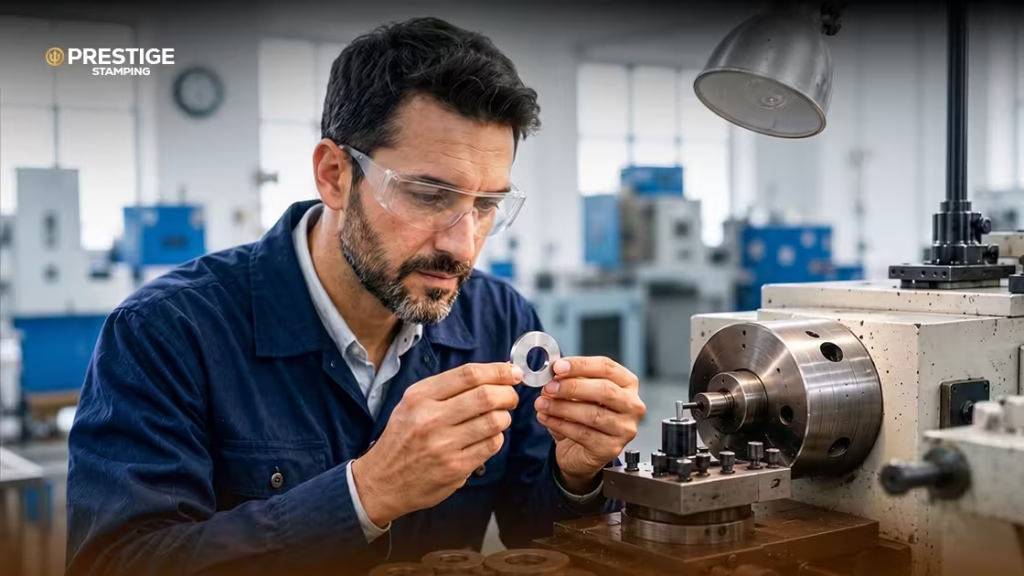
Stamped parts may undergo surface treatments such as plating, coating, heat treatment, or passivation to improve corrosion resistance, appearance, and durability. Finally, each batch undergoes rigorous inspection and quality control.
Manufacturers use specific quality control standards, CAD data, and stress testing to ensure their products meet expectations for quality and perform reliably in real-world applications. They also check dimensional accuracy and identify any deviations before components are shipped.
Major Metal Stamping Techniques
Metal stamping is a versatile manufacturing process that efficiently produces high-precision metal components. There are several stamping techniques that allow manufacturers to create parts with complex shapes, tight tolerances, and consistent quality for industries ranging from automotive to electronics.
| Technique | Best For | Engineering Advantage |
| Progressive Die | High-volume, complex parts | Maximum strokes per minute; integrated multi-stage forming. |
| Transfer Die | Large-scale structural parts | Ideal for parts that require 360-degree manipulation or have large footprints. |
| Four-Slide | Intricate clips/connectors | Unlimited forming angles for complex wire or strip geometries. |
| Deep Draw | Hollow, cylindrical, or boxed parts | Creates seamless, high-strength vessels with significant depth-to-diameter ratios. |
Progressive Die Stamping
A continuous metal strip passes through multiple stations in a single press. Each station performs a specific operation, gradually forming the part until it is fully completed.
Transfer Die Stamping
Parts are transferred between individual dies, with each stage carrying out a different operation. This allows multiple forming steps to be performed in sequence.
Four-Slide Stamping
Uses four independently moving slides to shape metal from multiple directions at the same time. This enables the production of detailed and complex parts in a single setup.
Deep Draw Stamping
Forms flat sheet metal into deep, three-dimensional shapes by stretching it into a die cavity, creating smooth, seamless components with uniform walls.
Types of Metal Stamping Processes
Metal stamping uses a variety of pressing and forming operations to shape metal into components with specific dimensions and functionality. These processes can be applied individually or in combination, depending on the complexity and requirements of the part being produced.
Blanking
Blanking cuts flat shapes from sheet metal, producing the initial outline of a part that will undergo further forming operations. It ensures clean edges and consistent dimensions, making it ideal for washers, brackets, and shims.
Punching
Punching is a metalworking process that uses a punch and die to create holes or cutouts in sheet metal. It’s fast, precise, and ideal for producing components like brackets, washers, and panels with consistent shapes and clean edges.
Bending
Bending forms angles, flanges, or folds, transforming flat blanks into three-dimensional shapes. It preserves material strength while providing structural geometry, which is essential for brackets, housings, and other functional components.
Forming
Forming reshapes metal without cutting. Using dies and presses, complex curves, contours, or structural features are created while maintaining material integrity. Forming is ideal for automotive panels, enclosures, and industrial machinery parts.
Coining
Coining applies localized high pressure to achieve fine detail, precise thickness, or embossed patterns. This process enhances functionality, improves tolerances, and can also add decorative or brand-specific features to parts.
Why Metal Stamping Matters in Manufacturing
Metal stamping plays a critical role in modern manufacturing by enabling the production of high-quality components at scale.
Consistent Quality at High Volume
Stamped parts are produced using precision tooling, ensuring uniformity across millions of components. This consistency is essential for assemblies that require an exact fit and function.
Cost Efficiency
Once tooling is established, metal stamping offers a highly cost-effective solution for large production runs. It reduces per-part cost while maintaining quality.
Production Speed
High-speed presses enable manufacturers to produce large quantities of parts quickly, supporting tight production schedules and meeting supply chain demands.
Material Optimization
Efficient die design minimizes material waste, helping reduce overall production costs and improve resource utilization.
Reliability in Critical Applications
In industries like automotive and industrial equipment, component reliability is non-negotiable. Metal stamping delivers parts that meet strict performance and durability requirements.
Applications of Metal Stamping Components
Metal stamping components are widely used across industries for their precision, consistency, and cost-effective production. Their ability to meet tight tolerances and perform reliably in demanding environments makes them essential in both high-volume manufacturing and specialized applications.
Automotive
Metal stamping plays a critical role in producing components such as brackets, body panels, clips, and terminals. These parts must meet strict quality and safety standards while supporting high-speed, large-scale production. Stamped components help reduce vehicle weight, improve fuel efficiency, and ensure structural integrity.
Agriculture
In agricultural equipment, stamped parts are used for supports, shields, enclosures, and fastening elements. These components are designed to endure harsh outdoor conditions, including moisture, dirt, and heavy mechanical stress, while maintaining long-term durability and performance.
Industrial Machinery
Stamped components are essential in machinery manufacturing, where strength and precision are critical. Parts such as housings, mounts, and connectors are produced to ensure consistent performance, smooth operation, and long service life in demanding industrial environments.
Electronics
The electronics industry relies on metal stamping for high-precision components like connectors, contacts, and shielding parts. These components require tight tolerances, excellent conductivity, and reliability to support complex electronic systems and devices.
Construction
In construction, metal stamping components are used in structural supports, brackets, fasteners, and fixtures. Their strength and uniformity make them ideal for building frameworks and infrastructure that require long-term stability and safety.
Aerospace
Aerospace applications demand lightweight, high-strength components with exact specifications. Metal stamping is used to produce critical parts that meet rigorous performance and safety requirements, ensuring reliability in extreme operating conditions.
Beyond these core sectors, metal stamping components also support industries such as medical devices, renewable energy, consumer goods, and telecommunications. Their versatility, precision, and scalability make them a reliable solution for a wide range of applications, reinforcing their importance in modern manufacturing.
Conclusion
Metal stamping is a foundational manufacturing process that supports the production of precision components used across critical industries. Its ability to deliver consistent quality, high efficiency, and scalable output makes it a reliable solution for modern manufacturing demands.
At Prestige Stamping, we move beyond the standard catalog. By integrating advanced die engineering with rigorous quality control, we deliver custom, non-washer components that meet the most demanding industrial tolerances. Need high-quality metal stamping components for your project?
Get in touch with us to source parts you can count on for real-world applications.