The most expensive problem on an automotive production line is not always the biggest part. Sometimes it’s a washer, bracket, clip, terminal, shield, spacer, or custom stamped metal component that arrives late, fails inspection, or does not match the required tolerance. For OEMs and Tier 1 and Tier 2 suppliers across Michigan and the Midwest, that small part can create a very expensive delay.
That is why automotive manufacturers continue to rely on custom metal stamping for precision metal stamping components that deliver on cost, quality, and speed — and why selecting the right automotive metal stamping partner matters as much as the component specification itself.
Why Custom Metal Stamping Matters in Automotive Manufacturing
Automotive manufacturing depends on repeatability. Every part must fit, function, and perform consistently under demanding production conditions.
Custom metal stamping supports that need by turning flat sheet metal or coil stock into finished components through precision tooling, dies, and high-speed presses. Depending on the part design and production volume, the process can take several forms:
- Progressive die stamping — a high-speed process where coil stock moves through a series of stations in a single die, completing multiple operations per stroke. Ideal for high-volume, tight-tolerance components.
- Transfer die stamping — individual blanks are transferred between separate die stations, suited for larger or more complex parts that require multiple forming stages.
- Single-hit and compound die operations — for lower-volume or simpler geometry components.
Within these processes, operations include blanking, bending, punching, piercing, coining, forming, and drawing. The right combination depends on part geometry, precision metal stamping materials, and required output volume.
In automotive metal stamping, stamped components are commonly used in:
- Structural support systems
- Fastening assemblies
- Brackets and mounting components
- Electrical terminals and connectors
- Seating and interior systems
- Powertrain-related assemblies
- Shielding and protective parts
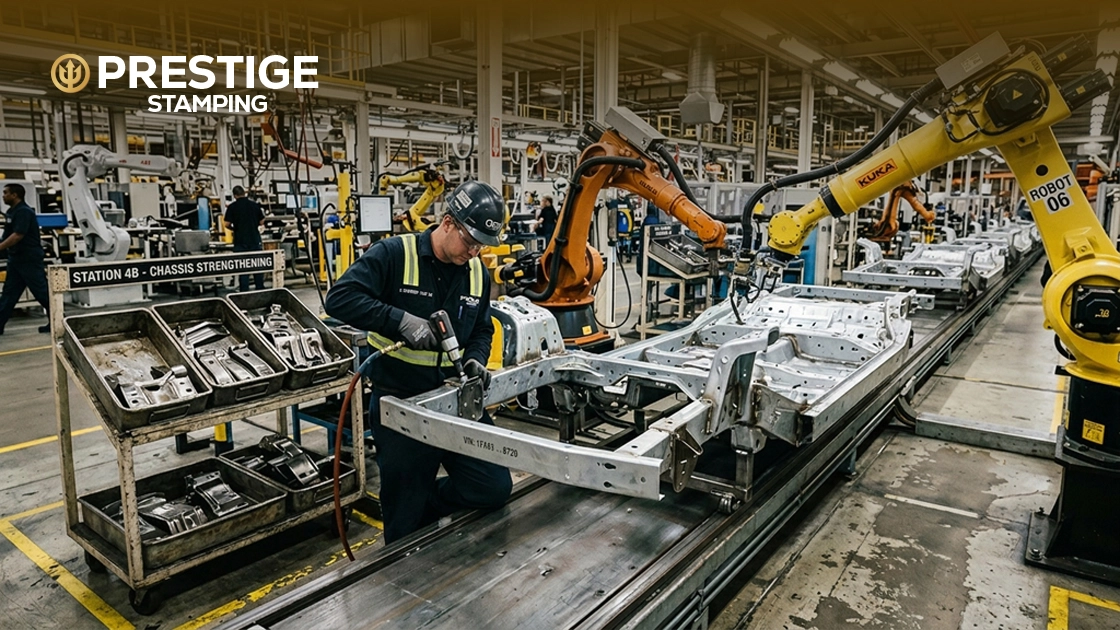
- Suspension and chassis applications
- Automotive sheet metal stamping for body and structural panels
Unlike off-the-shelf parts, custom stamped components are built around the exact application. Manufacturers can specify the material grade, thickness, tolerance, finish, strength, and production volume needed for the job. For procurement teams, that flexibility matters. Custom metal stamping services are not just a manufacturing process — they are a way to reduce sourcing risk, improve consistency, and support the full automotive production cycle.
Cost Efficiency: Lower Total Cost, Not Just Lower Unit Price
In automotive sourcing, the lowest quote is rarely the lowest cost. A cheaper component can become expensive quickly if it causes late shipments, poor fit, rework, scrap, warranty issues, or assembly delays.
Custom metal stamping helps control costs in several ways:
- Progressive Die Tooling Efficiency: Progressive die tooling and high-speed presses produce large volumes of consistent components, spreading the tooling investment across longer production runs and lowering the per-part cost over time. Long-run progressive stamping is particularly cost-effective for automotive programs that require high-volume, repeatable output.
- Reduced Secondary Operations: A well-designed die can integrate multiple features — holes, bends, forms, tabs, and coined details — into a single progressive die stamping process. This reduces manual handling, labor, and extra production steps.
- Material Utilization: Efficient strip layout and die design minimize scrap, which matters when material costs fluctuate.
For Michigan and Midwest automotive manufacturers, proximity adds another cost advantage. Working with regional custom metal stamping services can reduce freight complexity, communication delays, and long-distance supply chain risk. Overseas sourcing may look attractive on a unit-price basis, but long transit times, port delays, customs issues, and unpredictable logistics create hidden costs that compound quickly.
Domestic proximity gives buyers more control. When engineering changes, urgent orders, or production adjustments come up, a regional partner responds faster than an offshore supplier. That is the real cost advantage: not just a lower unit price, but a lower total cost of ownership.
Quality: Precision Metal Stamping Requires Rigorous Process Control
Automotive manufacturing does not forgive inconsistency. Any of the following can create delays that far exceed the value of the part itself:
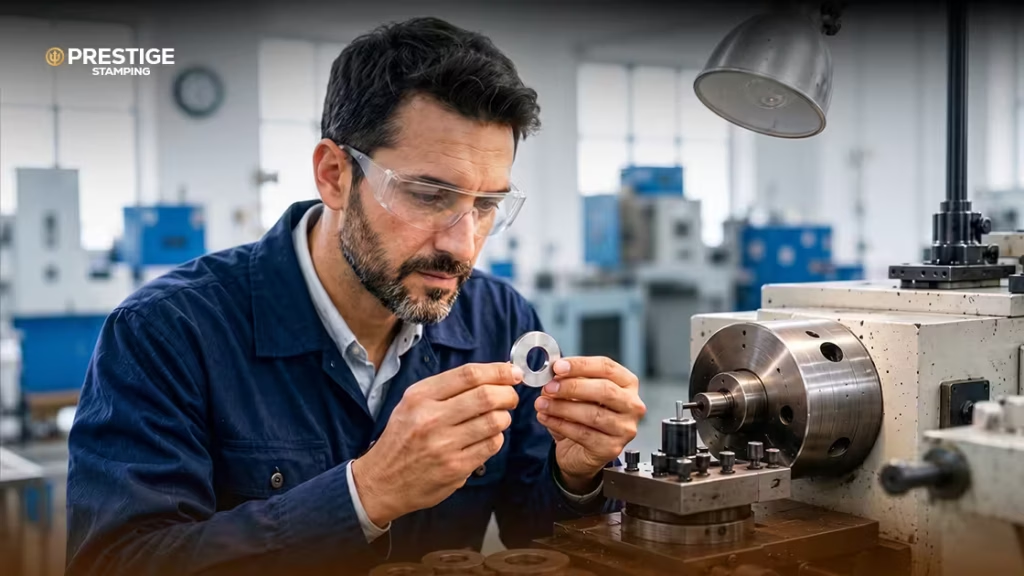
- A washer slightly out of tolerance
- A bracket with poor edge quality
- A stamped part with inconsistent hardness
- A component that fails inspection during final assembly
That is why quality is central to Tier 1 supplier stamping. Among automotive metal stamping companies, the best performers rely on controlled tooling design, repeatable press operations, in-process inspection, and fully traceable materials — not just fast production output.
Certifications matter as well. Prestige Stamping’s capabilities include IATF 16949 and ISO 9001 certifications, supported by a 102,000 square foot facility in Warren, Michigan, built for domestic precision metal stamping production and distribution.
Quality also depends on communication before production begins. A strong stamping partner reviews part geometry, material thickness, tolerance requirements, and finishing needs before the part reaches full-scale manufacturing. This early engineering review prevents premature tool wear, material cracking, and poor fit during assembly. In automotive metal stamping, quality is not inspected at the end — it is engineered into the process from the beginning.
Speed: Domestic Automotive Metal Stamping Services Protect Production Schedules
Speed is not only about how fast a press runs. In automotive procurement, speed means how quickly a supplier moves from quote to tooling, from tooling to production, and from production to delivery.
When components are sourced overseas, timelines are exposed to several risks: ocean freight delays and port congestion, customs clearance issues, international communication gaps, long replenishment cycles, and limited flexibility when demand forecasts shift.
A Michigan-based metal stamping parts manufacturer gives OEMs and suppliers a shorter, more dependable supply chain. Local sourcing also improves collaboration — engineers, purchasing teams, and production managers can communicate directly and solve problems without working across time zones.
Prestige Stamping’s high-speed press room features 22 presses ranging from 35 to 250 tons, backed by automated optical sorting, in-house material availability, plating options, and heat treat capabilities. For automotive manufacturers, that combination supports faster turnaround without compromising quality control.
The Custom Advantage: Custom Precision Metal Stamping Built Around the Application
Standard components have their place, but many automotive programs require parts designed around specific assembly, performance, or material requirements. Custom sheet metal stamping allows manufacturers to define the details of the job: material grade, dimensional tolerance, corrosion-resistant finish, thickness, hole pattern, and unique bends or forms.
This flexibility is especially important for precision metal stamping components that fit directly into larger assemblies — seating mechanisms, brackets, fastening systems, electrical connections, shielding parts, or powertrain-related components. If the part does not fit correctly, the issue moves down the line. Custom precision metal stamping reduces that risk by aligning the component with the original engineering intent from the start.
Why Midwest Automotive Manufacturers Benefit from a Regional Metal Stamping Manufacturer
Michigan remains one of the strongest automotive manufacturing hubs in the United States, supported by a dense network of OEMs, Tier 1 suppliers, Tier 2 suppliers, toolmakers, and logistics providers. That regional concentration makes supplier proximity a real advantage.
Working with Midwest automotive metal stamping facilities can help manufacturers improve lead time reliability, freight efficiency, communication, and emergency response. When production schedules change or urgent component needs arise, a regional metal stamping manufacturer responds with more flexibility than an overseas supplier.
In a market where global supply chain disruption has become a recurring concern, domestic sourcing is no longer just a preference — it is a practical way to reduce risk and protect production schedules.
Frequently Asked Questions
What is progressive die stamping and why does it matter for automotive parts?
Progressive die stamping is a metal forming process in which coil stock feeds through a series of stations within a single die. Each station performs a specific operation — blanking, punching, bending, forming — so that a finished part exits with every press stroke. For automotive metal stamping, this makes progressive die stamping highly efficient for high-volume components that require tight dimensional tolerances across long production runs.
How does the automotive metal stamping process work?
The automotive metal stamping process begins with selecting the correct material grade and coil thickness, then designing the tooling to match part geometry and tolerance requirements. Sheet metal or coil stock is fed into precision presses, where it is formed through progressive, transfer, or single-hit die operations. Parts undergo in-process inspection before moving to finishing, plating, or heat treat as required.
What materials are used in precision metal stamping?
Common precision metal stamping materials for automotive applications include cold-rolled steel, high-strength low-alloy (HSLA) steel, stainless steel, aluminum alloys, and copper-based alloys for electrical components. Material selection depends on strength requirements, corrosion resistance, weight targets, and the specific automotive metal stamping application.
Here’s What Matters Next
Every automotive purchasing decision comes back to three questions:
- ✅ Can the supplier control cost?
- ✅ Can the supplier meet quality expectations?
- ✅ Can the supplier deliver on time?
Custom metal stamping services answer all three — when the right partner is involved.
At Prestige Stamping, we understand that automotive manufacturers need more than production capacity.
From our Warren, Michigan facility, we provide precision metal stamping with regional support and a team built to deliver critical components right. As an IATF 16949-certified precision metal stamping manufacturer, we support quality, speed, cost control, and domestic supply chain reliability simultaneously.
Ready to secure precision automotive components for your next program? Consult with our Michigan-based engineering team or request a quote for your next automotive project today.