A multi-million dollar assembly line can grind to an absolute halt over one single noncompliant washer.
When manufacturing heavy-duty infrastructure or complex automotive systems, the biggest production risks rarely hide in the massive structural frames in metal stamping process. They hide in the smallest fastening components.
Today, as Industry 4.0 rapidly reshapes global manufacturing, advanced automation is actively neutralizing that risk. For high-volume components like washers and solid rivets, tight engineering tolerances leave absolutely zero room for error.
For manufacturing engineers, plant managers, and OEM buyers, automated metal stamping is no longer optional. It is the foundation for delivering reliable, efficient, and future-ready production.
Why Automation Matters in Washer and Rivet Production
Washers and rivets may be small components, but they play a critical role in maintaining structural integrity across modern industries. From automotive assemblies to heavy infrastructure projects, these parts must perform consistently under demanding conditions.
Manual or semi-automated processes introduce variability, which can lead to:
- Inconsistent dimensions
- Surface defects
- Material waste
- Production delays
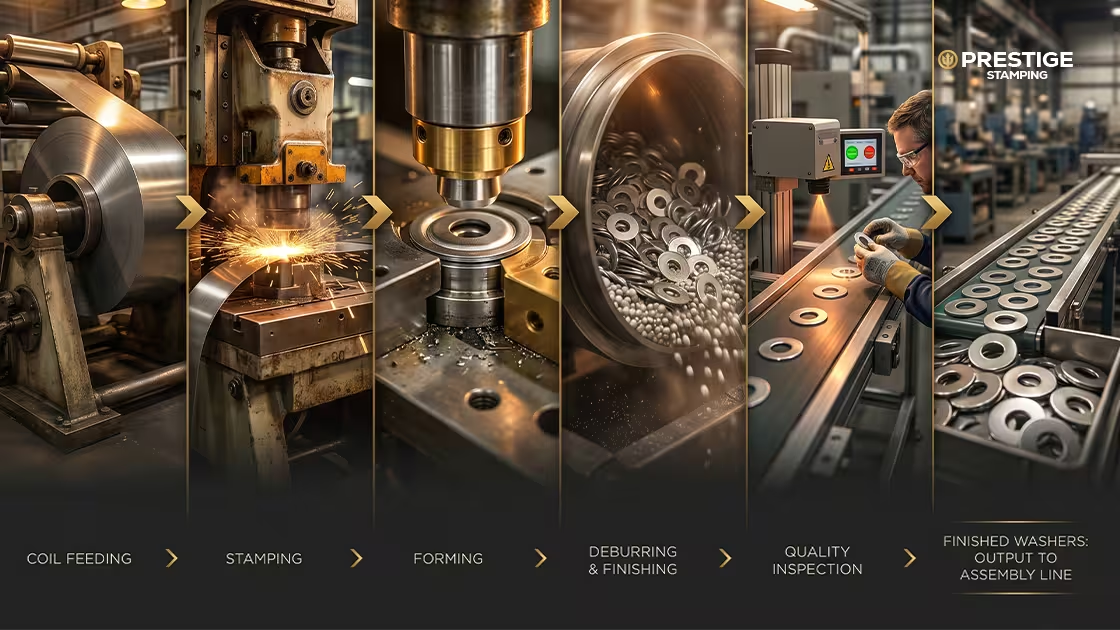
Automation addresses these challenges by introducing precision-driven systems that operate with minimal deviation. In modern stamping facilities, automated presses, sensors, and real-time monitoring systems work together to ensure each component meets exact specifications.
This level of control is essential in high-volume washer manufacturing and rivet production, where consistency directly impacts performance and reliability.
Reduced Scrap and Material Waste
One of the most immediate benefits of automated stamping is the reduction of scrap.
In traditional setups, variability in material feeding, die alignment, or press operation can result in defective parts. Over time, this leads to increased material waste and higher production costs.
Automated systems reduce these risks by ensuring:
- Accurate material feeding
- Consistent press force
- Real-time defect detection
Advanced stamping lines use sensors to monitor each stage of production. If a deviation occurs, the system can adjust instantly or stop production to prevent further waste.
For plant managers, this results in lower raw material costs, reduced rework, and improved efficiency. Even a small reduction in scrap can lead to significant savings in high-volume production environments.
Achieving Higher Tolerance Consistency
Tolerance consistency is critical in small-part manufacturing. Washers and rivets must fit precisely within assemblies, often under conditions involving vibration, pressure, and temperature changes.
Automation improves tolerance control by removing human variability from the process. Key advantages include:
- Repeatable press operations with precise force control
- Accurate tooling alignment
- Consistent cycle timing
With automated systems, each part produced is nearly identical to the last. This level of repeatability is essential for OEM buyers who depend on consistent quality across large production runs.
For manufacturing engineers, this means fewer assembly issues, reduced failure rates, and improved product performance.
How Automation Improves Production Efficiency
Automation also enhances production speed and throughput.
Automated stamping systems are designed for continuous operation, with minimal downtime and faster cycle times compared to manual processes. Key efficiency gains include:
- High-speed press operation
- Automated part handling and sorting
- Reduced need for manual intervention
By streamlining production, manufacturers can meet higher demand without compromising quality.
For OEM buyers, this ensures reliable supply chains and faster delivery timelines. For plant managers, it means better use of equipment and labor resources.
Real-Time Monitoring and Quality Control
A key advantage of automation is the ability to monitor production in real time.
Modern stamping systems use sensors and data tracking tools to provide immediate insights into performance. These systems allow manufacturers to:
- Track production metrics
- Detect defects instantly
- Maintain consistent quality standards
Instead of relying on post-production inspection, automated systems maintain quality throughout the process.
This proactive approach reduces the risk of defective parts reaching customers and strengthens overall quality assurance.
Delivering Real ROI for OEMs and Manufacturing Leaders
Automation is not just about improving production processes. It delivers measurable returns across the entire value chain.
For OEM buyers and manufacturing leaders, the benefits include:
- Lower Total Cost of Ownership – Reduced scrap, fewer defects, and improved efficiency drive long-term cost savings.
- Improved Product Quality – Consistent tolerances and reliable performance reduce the risk of failures and warranty claims.
- Stronger Supply Chain Reliability – Automated production ensures consistent output and timely delivery, even at high volumes.
- Scalability for Future Demand – Automation allows manufacturers to scale operations without sacrificing quality or efficiency.
These advantages position automated stamping as a strategic investment rather than an optional upgrade.
Building the Future with Precision at Prestige Stamping
The industrial manufacturing landscape continues to rapidly evolve, but our core philosophy remains anchored in pure capability.
Talk is cheap when production lines are down. That is exactly why our 102,000 square foot facility in Warren, Michigan, operates as a fully integrated hub of advanced automation. We do not just claim quality; we engineer it directly into the process.
By utilizing advanced inline sensors, automated optical inspection, and precision servo technology, we physically guarantee that every single component meets exact structural demands before it ever leaves our floor.
Our strict “Melted” and “Manufactured” in the USA commitment further supports this by completely eliminating the massive logistical variables of offshore sourcing. We provide a highly secure, heavily localized supply chain built entirely on verifiable precision.
Final Thoughts
Automation is redefining washer manufacturing and rivet production. It improves efficiency, enhances quality, and delivers measurable ROI across operations.
For manufacturing decision makers, the message is clear: Automated metal stamping is no longer a competitive advantage. It is a requirement for building reliable, scalable, and future-ready production systems.
Ready to bulletproof your component sourcing? Contact our engineering team or download our capability statement to see how automated stamping changes the equation.