For maintenance engineers, technicians, and design engineers, choosing the right fastener for an assembly is a critical step. When facing the same fastening job, you must often choose between two major fastener families, and making the wrong choice means ending up with either a joint that is weaker than it needs to be or a joint you cannot physically install. When comparing a solid rivets vs blind rivets, the most important factor that decides the vast majority of cases before anything else is simple: do you have access to both sides of the joint?
This guide will explore what separates the two fasteners mechanically, provide a clear decision framework for your assembly line, and highlight exactly where each rivet type wins in real-world industrial practice. Lets dig in to know about solid rivets vs blind rivets
Table of Contents
How Solid Rivets Work
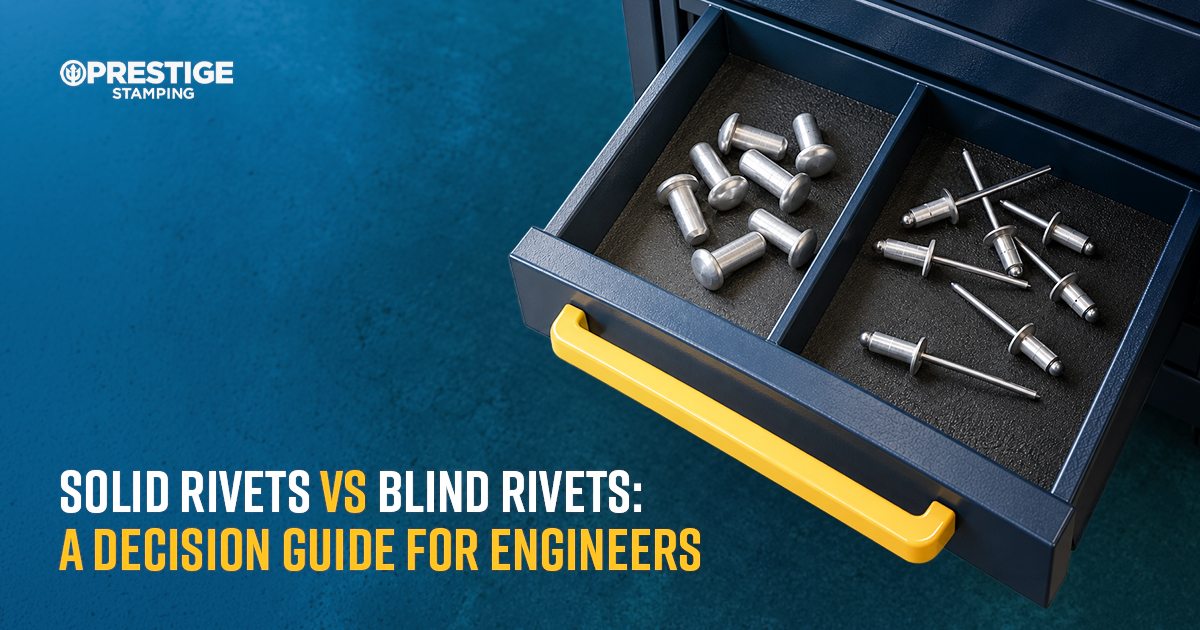
A solid rivet is a one-piece fastener consisting of a solid head and shank. The defining characteristic of a solid rivet is that it requires access to both sides of the assembly for proper installation.
The fastener is installed by deforming the protruding tail end of the rivet into a second head, typically while a heavy bucking bar backs the original head from the opposite side to absorb the impact. Because there is no mandrel or hollow shank involved in the design, a solid rivet inherently possesses higher shear and tensile strength per diameter than a comparable blind rivet.
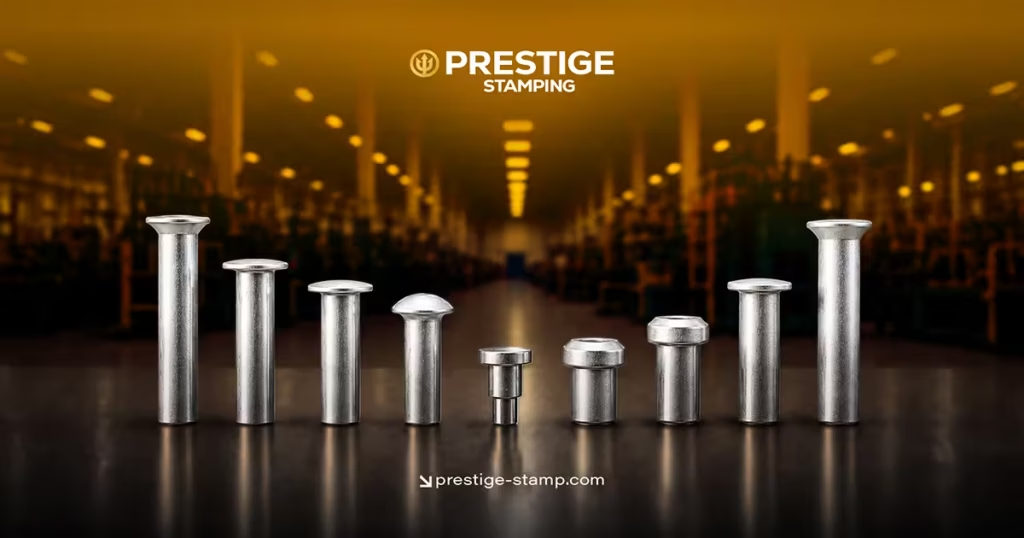
The trade-off here is stated plainly: you gain maximum strength and permanence, but you absolutely must be able to reach both sides of the joint to install it. For critical assemblies, this strength is non-negotiable. At Prestige Stamping, we have been America’s trusted source for solid rivets since 1952, producing over 4 million rivets daily across standard, aluminum buck, miniature, and shoulder configurations.
How Blind Rivets Work
A blind rivet (often referred to generically as a pop rivet) features a hollow shank equipped with a central mandrel. The defining advantage of a blind rivet is that it can be installed from one side only: the “blind” side.
During installation, a specialized tool pulls the mandrel through the hollow shank. This action crushes and expands the blind end of the rivet to form a second head on the inaccessible side of the joint. Once the required clamping force is reached, the mandrel snaps off.
The trade-off is clear: a blind rivet works perfectly when you cannot reach the backside of an assembly, but the resulting joint is mechanically weaker than an equivalent solid rivet. Furthermore, the specific locking style of the blind rivet, whether a mechanical-lock or a friction-lock, heavily affects its long-term vibration resistance.
The Decision Framework
When evaluating fastening options on the shop floor, follow this sequence to determine the correct specification:
- Can you access both sides of the joint?
- If no, a blind rivet is the only option, regardless of other strength factors.
- If yes, does the application need maximum shear strength and permanent structural integrity?
- If the assembly is for heavy equipment, structural steel, or high-vibration environments, the solid rivet is the required choice.
- If yes (two-sided access is available), but installation speed and one-person assembly matter more than maximum strength?
- In cases where high-volume assembly speed supersedes the need for maximum mechanical strength, blind rivets are usually still the practical choice.
- Does the joint need sealing against liquid or gas?
- If environmental sealing matters, you must specify closed-end blind rivets, which are distinct from standard open-end blind rivets designed for general fastening.
Strength and Load Comparison
Understanding the “why” behind the decision framework comes down to fundamental load capacities. Solid rivets carry significantly higher shear and tensile strength per diameter because they have no hollow shank or mandrel to weaken the fastener’s cross-section. They are solid metal through and through.
Blind rivets attempt to close this performance gap with specialized structural or heavy-duty variants (sometimes referred to in the industry as Huck-style fasteners). These serve as a valuable middle ground between standard blind rivets and traditional solid rivets.
When it comes to vibration resistance, the performance gap widens. A blind rivet’s resistance to vibration depends heavily on its locking style; while mechanical-lock variants hold up well, friction-lock variants can eventually work loose. Solid rivets, by their very design, are inherently vibration-resistant and permanent.
Installation Differences Between Solid Rivets vs Blind Rivets
The installation processes for these two fasteners dictate your labor costs and tooling requirements.
- Solid Rivets: Installation typically requires a two-person team or a rigidly braced setup. The process utilizes a pneumatic hammer paired with a bucking bar, or an automated rivet squeezer. It is generally a slower process per individual rivet.
- Blind Rivets: Installation is a one-person, one-sided operation. Using a hand-powered or pneumatic rivet tool, the process is incredibly fast and exceptionally well-suited to high-volume assembly lines.
For a detailed, step-by-step breakdown of the specific tooling and techniques required for both methods, please review the installation walkthrough in our Complete Guide to Industrial Rivets.
Where Each One Wins in Practice
Based on our experience supplying the automotive, structural, aerospace, defense, and agricultural sectors, here is where each fastener dominates:
Where Solid Rivets Win: Because they represent the industry standard for permanent assembly, solid rivets are mandated for structural steel, heavy equipment framing, permanent high-load joints, and boiler or pressure vessel work. For example, our Aluminum Buck Rivets are utilized heavily for marine and trailer applications requiring lightweight strength, while our Miniature Rivets (down to .020″ diameter) provide high reliability for electronics and instruments.
Where Blind Rivets Win: Blind rivets are the undisputed champion for enclosed assemblies where the back side is never accessible again once closed. This includes HVAC ductwork, electrical enclosures, and specific automotive body panels. They are also the preferred choice for rapid field repairs and general sheet metal fabrication.
Conclusion
When it comes down to it, physical access decides whether you have a choice at all, while strength requirements decide which one you should pick if both sides are reachable.
If you are evaluating fastener types for a new engineering program and need to explore sizes, materials, and custom cold-headed specials, we recommend reviewing our Complete Guide to Industrial Rivets to view a full type-by-type breakdown.
Frequently Asked Questions
Can a blind rivet ever be as strong as a solid rivet?
Generally, no. Because a blind rivet relies on a hollow shank and a snapped mandrel, its cross-sectional strength cannot match that of a solid piece of cold-headed metal of the exact same diameter.
What is a structural blind rivet and when should I use one instead of a solid rivet?
A structural blind rivet (often a mechanical-lock style) is engineered to retain the mandrel tightly within the shank, increasing its shear strength. You should use one when you need high structural strength but physically cannot access the back of the joint to buck a solid rivet.
Do blind rivets work in high-vibration environments?
They can, provided you select the correct variant. Standard friction-lock blind rivets can work loose under heavy vibration, whereas mechanical-lock structural blind rivets perform much better. However, solid rivets remain superior for extreme vibration.
Can you use a solid rivet if you only have access to one side?
No. A solid rivet absolutely requires access to both the front (to drive the head) and the back (to buck and deform the tail). If you only have one-sided access, you must use a blind fastener.